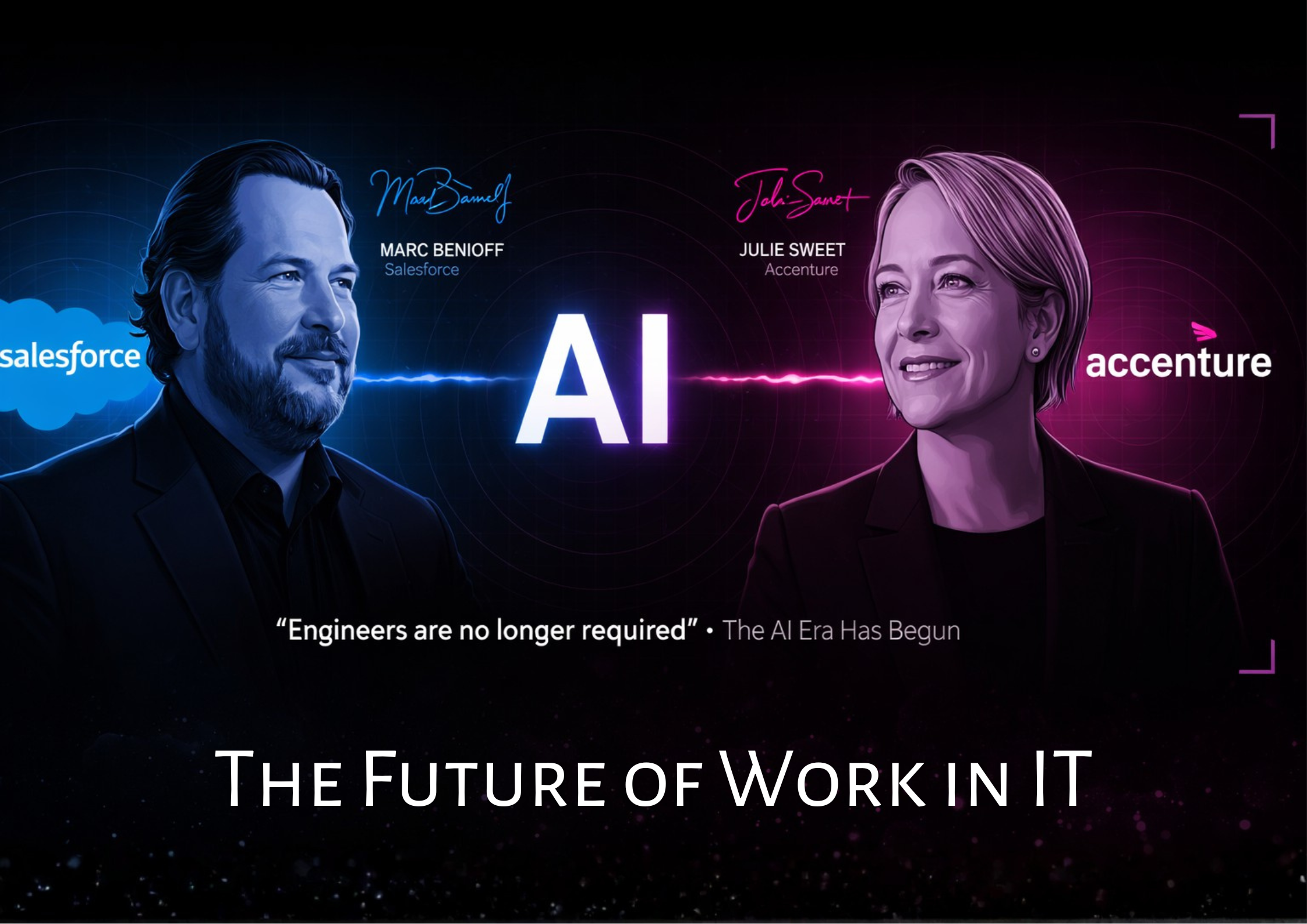
Two of the world’s most powerful CEOs just confirmed what designers have quietly suspected , the workforce as we know it is being rewritten by AI.
Here’s what it means for the rest of us.
When the CEO of Salesforce publicly declares he will not hire a single software engineer this year, and the CEO of Accenture tells analysts that the “pilot phase” of AI is officially over, you stop and pay attention. This isn’t a prediction. This isn’t a TED Talk. This is corporate strategy, announced on earnings calls, with billions of dollars behind it.
We are living through the fastest workforce restructuring in the history of technology. And yet, most people in design, product, and tech are still debating whether AI is a “tool” or a “threat.” The answer, it turns out, is neither. AI is infrastructure. And the companies that treat it as such are already pulling away.
The Announcement That Changed Everything
On a recent earnings call, Salesforce’s Marc Benioff made a statement that cut straight through the noise of AI hype: no new software engineers would be hired in 2026. Not because budgets are tight. Not because of a hiring freeze. But because Agentforce, Salesforce’s AI-powered agentic platform, had delivered a 30% jump in productivity making additional engineering headcount simply unnecessary.
His words: “We are the last generation to manage only humans.”
That line deserves a pause. “The last generation to manage only humans.” It’s not a warning. He said it with the confidence of someone describing a market shift that already happened. AI agents are now part of the workforce. They don’t clock in. They don’t ask for equity. They scale.
And Salesforce isn’t alone in this thinking. While engineers get frozen out, the company is aggressively expanding its sales team hiring up to 2,000 new salespeople. The message hidden in that number is the most important thing to understand: AI replaces execution; humans are still needed for trust.
Accenture Goes Further: We’re Past the Pilot Phase
If Benioff’s announcement was a signal flare, Accenture’s Julie Sweet fired the cannon. During her own earnings call, Sweet declared that the enterprise world has moved beyond experimentation. AI is no longer being tested in sandbox environments or run as isolated proofs of concept. It is now being wired directly into what Accenture calls the “digital core” of businesses.
Her words : “At this point, AI is permeating everything we do. You have to be a leader to win at the levels we’re winning.”
Sweet also highlighted something that most AI commentators overlook entirely: legacy modernisation. Mainframe migration, historically one of the most expensive, risk-heavy, and margin-crushing projects an enterprise could undertake, is now becoming viable and even high-margin because of AI.
The real unlock: AI isn’t just automating new work. It’s finally making the old, broken, expensive work possible. That’s a $10 trillion opportunity sitting inside legacy infrastructure, and Accenture is betting it gets there first. What Designers Should Take From This
Here’s the part most design content won’t tell you. Both of these announcements are, at their core, design problems.
When Salesforce deploys AI agents to handle work that engineers once did, someone has to define how those agents behave, how users trust them, how errors are surfaced, how the experience feels. That’s not a machine learning problem. It’s a human-centred design problem.
When Accenture embeds AI into a client’s digital core, the question isn’t just “does it work?” The question is “do people use it, trust it, and actually change their behaviour because of it?” Again – that’s design. That’s user research, information architecture, interaction design, and change management wrapped into one.
AI is eating the executor. But the person who decides what should be built, and why, and for whom – that job just got more important.
A Designer’s honest take on 2026
The designers who are thriving right now aren’t the ones who mastered the latest Figma plugin or the cleverest AI image generator. They’re the ones who position themselves as strategic thinkers, people who understand business outcomes, user psychology, and system design well enough to direct AI, not just use it.
The New Workforce Hierarchy Is Already Here
Think about what both CEOs are actually saying. Salesforce is hiring salespeople, communicators, relationship builders, closers. Accenture is winning on strategy, ecosystem partnerships, and integration expertise. Neither is doubling down on raw technical output.
The hierarchy forming in the AI era looks something like this: at the top are strategic thinkers, people who decide what AI should do and why. Below them are integrators, people who connect AI to real systems and real users. At the bottom is pure execution, and that’s where Agentic AI is rapidly taking over.
Designers, by training, live in that top tier. We ask “why before how.” We prototype before we build. We validate before we ship. These habits, often undervalued in the engineering-heavy culture of tech, are now exactly what the AI era demands.
The Question You Need to Answer Right Now
Both of these companies made their moves based on one simple calculation: what humans do that AI can’t replicate at scale. For Salesforce, it’s selling , building relationships and closing deals. For Accenture, it’s strategy , knowing what to deploy, when, and how.
For you, the question is the same. What do you bring to the table that an AI agent running on a $20/month subscription cannot? If the answer is “I make screens” or “I write code” you need a new answer. Fast.
But if the answer is “I understand users,” “I can translate ambiguity into clarity,” “I design systems that humans actually trust”, then welcome to the most important design era in history.
The pilot phase is over. The real work has started.